
Reframing Quality Control
Verification Explains Outcomes. Execution Is the Only Chance to Change Them.
Quality assurance processes in asphalt paving are highly developed.
Density cores, nuclear gauge readings, intelligent compaction maps, and reports all play a role in verifying that work meets specification. These tools are essential for documentation, accountability, and program oversight.
But verification alone does not change outcomes.
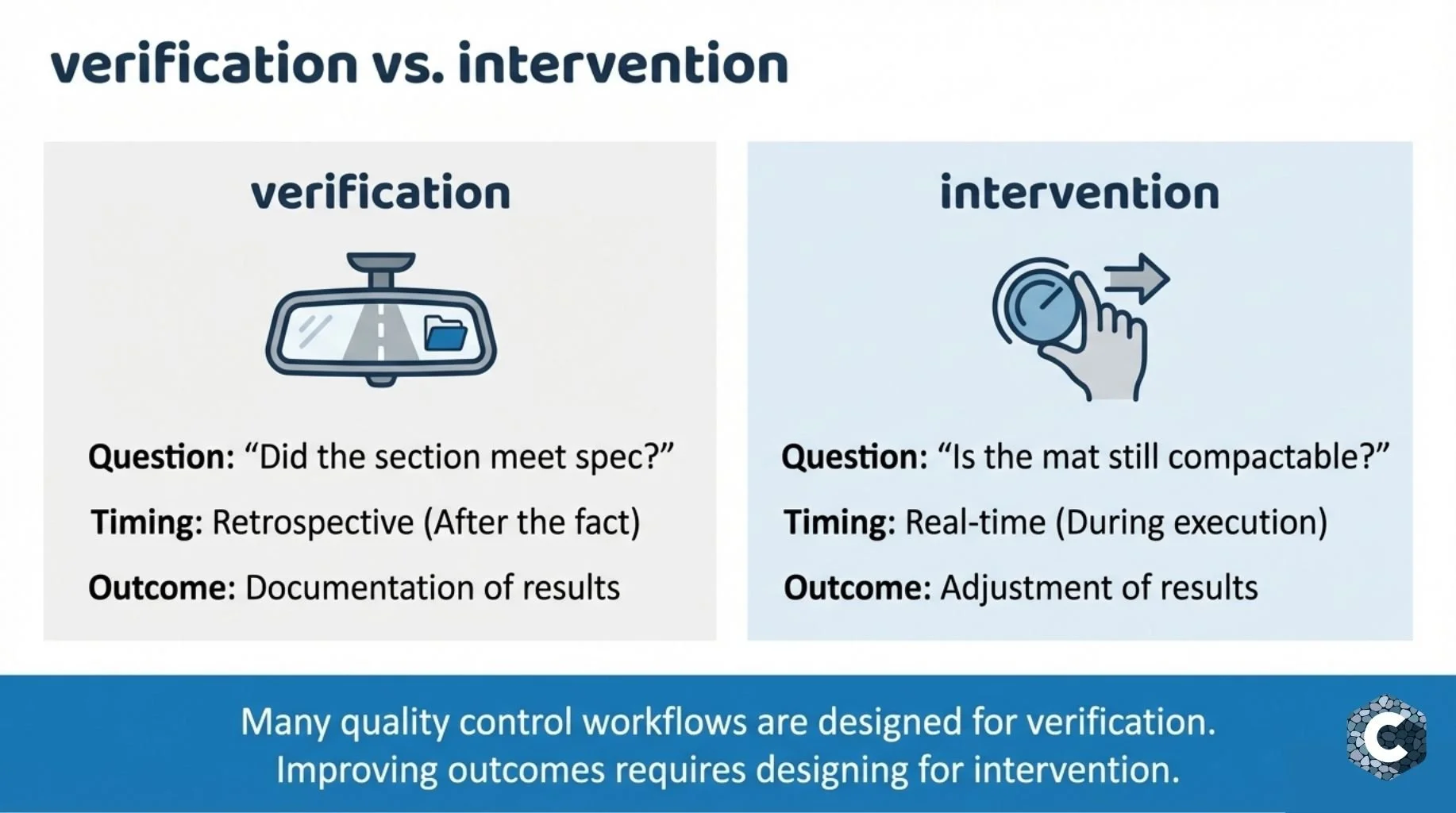
Reframing Asphalt Quality Control
Verification answers different questions
Verification workflows are designed to answer questions such as:
Did the pavement meet specification?
Can results be documented and audited?
Is the work defensible after completion?
These questions are important, but they are asked after the work is largely complete.
Execution asks a different question:
What should be done right now to influence the outcome?
The structural limitation of verification
Most verification data is reviewed:
After a section is complete
After rollers have left the area
After the mat has cooled beyond effective compaction
At that point, the data can explain what happened, but it cannot change what happened.
This is not a failure of QA systems. It is a mismatch between workflow timing and decision timing.
Why this distinction matters in practice
In many projects:
Density issues are identified after paving has progressed
Variability is documented rather than corrected
Lessons learned are applied to future work, not current sections
This approach assumes that future conditions will be sufficiently similar to benefit from retrospective learning. In reality, mix temperature, lift thickness, ambient conditions, and logistics can change rapidly.
Execution happens in a narrow window
Execution influence exists only while:
Rolling patterns can still be adjusted
Coverage can still be increased or redistributed
Temperature remains within a workable range
Once that window closes, verification becomes the only remaining function.
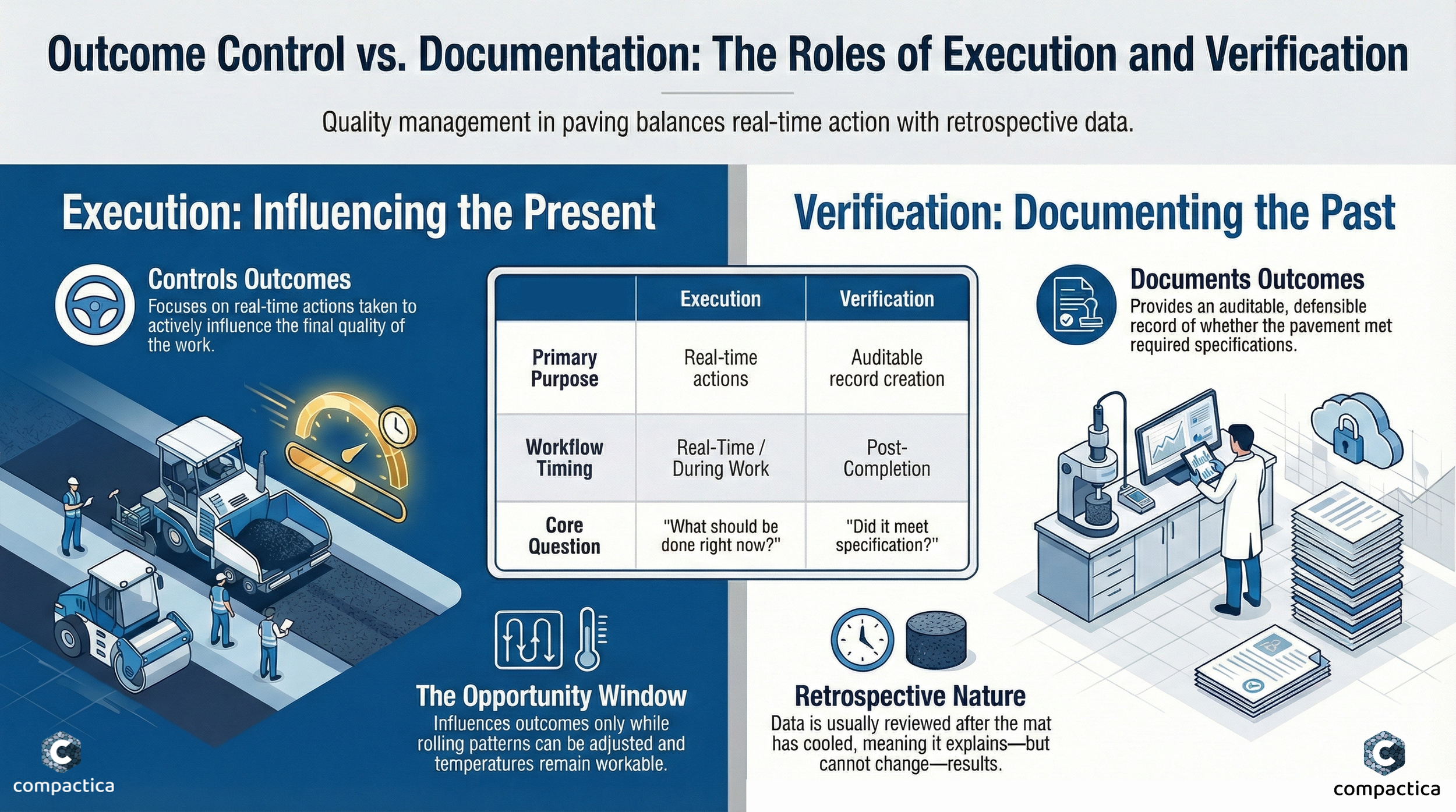
Outcome Control vs Documentation - Compactica
Reframing quality control
Execution and verification are not competing ideas. Both are necessary.
But they serve different purposes:
Execution controls outcomes
Verification documents outcomes
Confusing the two leads to workflows that are excellent at explanation and weak at influence.
How much of your current compaction workflow is designed to influence outcomes—rather than just verify them after the fact?
Ready to influence outcomes? Contact Us
References
FHWA. Guide to Quality Assurance Procedures for Construction.
AASHTO. R 82 – Standard Practice for Intelligent Compaction.
NCHRP Report 676. Quality Control/Quality Assurance Practices for Pavement Construction.
Asphalt Institute. The Role of Quality Control in Asphalt Pavement Construction.